
Canada Special Delivery Air Mail Cover between Irving from MONTREAL to Julius Forstmann Corporation in NEW YORK on advertising cover PA19461106

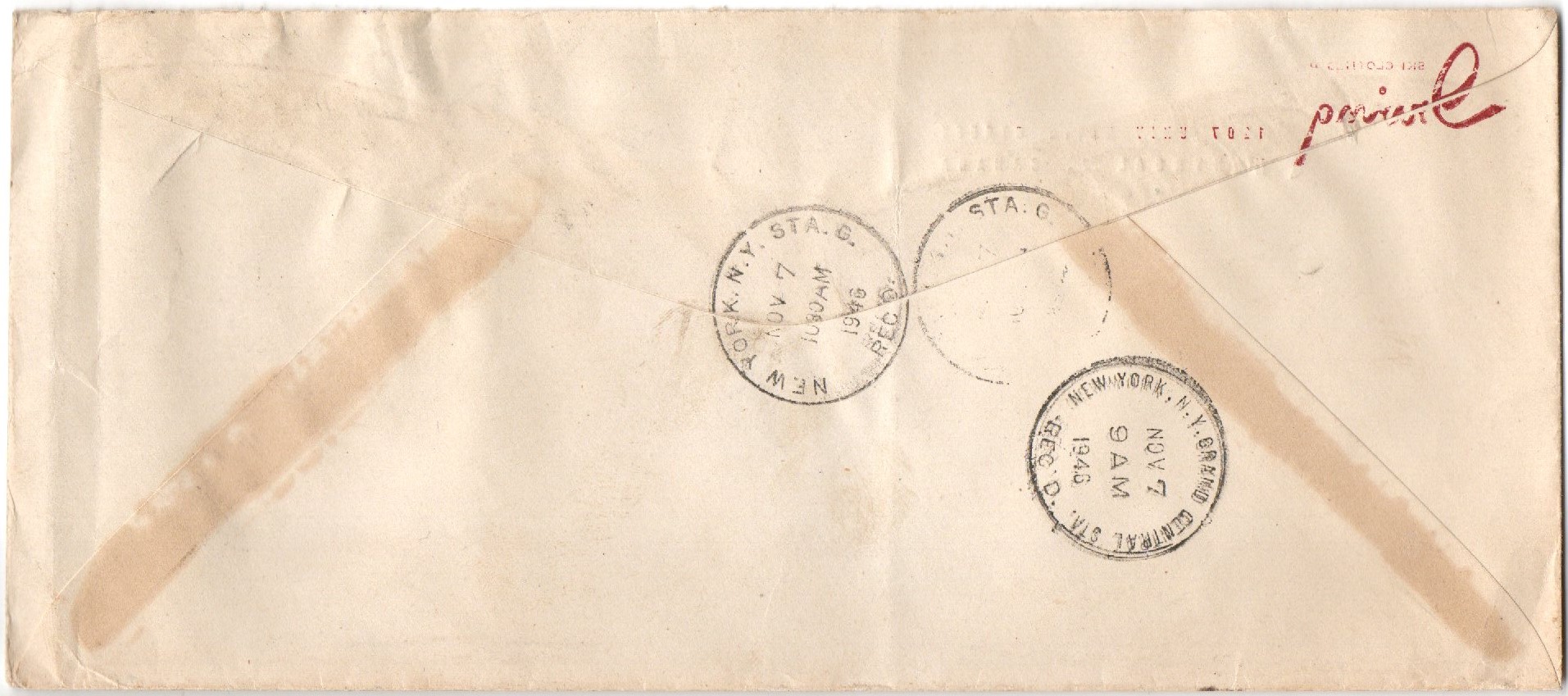
Canada Special Delivery Air Mail Cover between Irving from MONTREAL to Julius Forstmann Corporation in NEW YORK on advertising cover PA19461106
$45.00
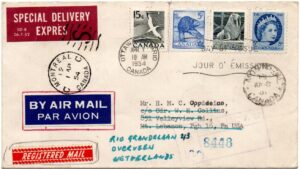
Canada Special Delivery Air Mail Cover between Irving from MONTREAL to Julius Forstmann Corporation in NEW YORK on advertising cover. MONTREAL P.Q. STATION B “S” November 6, 1946, cancel on a pair of War Issue 1 cent #249 to pay the 2 cents War Tax, the 7 cents Canada Gease near Sudbury Ont. the last Air Mail stamp of Canada #C9 issued September 16, 1946, paying the Air Mail letter rate and a 10 cents Special Delivery stamp #E11 issued September 16, 1946. Receivers cancel NEW YORK N.Y. STA.G. REG’D November 7, 1946 and NEW YORK N.Y. GRAND CENTRALSTA. REG’D November 7, 1946. Both a SPECIAL DELIVERY EXPRÈS SD-8 Label and BY AIR MAIL PAR AVION. Extremely interesting and early usage advertising cover a rare find.
IRVING CLOTHING, MONTREAL
Irving of Montreal, the brand name of tailor, manufacturer and designer Irving Margolese (1918-?), was once the leader in North American skiwear. Irving garments were worn by Hollywood stars Norma Shearer, Joan Caulfield, Jane Russell, Burgess Meredith, and Gary Cooper. His ski and sportswear apparel appeared in Vogue, Harper’s Bazaar, and the New York Times Magazine, and he dressed several Canadian Olympic teams. By 1947, Irving was described as “one of Canada’s most prominent designers” and called himself “America’s Foremost Skiwear Designer.”
In 1939, Margolese gained attention for the ski uniforms he designed for Canadian women competing in an invitation tournament in Lake Placid. This moment was the catalyst for his three-person tailor shop to transform into a large manufacturing business.
By 1945, he was known for being the first North American designer to create “downhill slacks” and a tuck-in ski top that cut down on wind resistance and snow collection.
His streamlined cotton and wool gabardine ski pants, known in ski communities as “Irvings,” were made from imported tightly woven English gabardine fabrics. The taper from knee to ankle allowed for movement while reducing wind resistance. Early designs of his ski pants, called “Slack-Ski,” featured detachable leather stirrup straps and ankle side-zipper panels for after-ski comfort.
In the latter half of the 1950s, these evolved into stretch pants using man-made blended fabrics. His tuck-in tops offered the same wind and snow resistance. In 1950 and 1951, he offered them in an exclusive, British-loomed Egyptian cotton poplin fabric called Wethrcloth. A three-piece ski suit (consisting of a tuck-in parka, tapered pants, and a wrap-around hood) and a one-piece ski suit were also notable design developments pioneered by Irving in the late 1940s.
In 1950 he introduced hoods that rolled down into jacket collars and, in 1952, European-inspired knickers that came just below the knee for increased freedom of movement.
Reversible parkas in various colors and prints were popular features in Irving of Montreal collections from 1956 into the 1960s.
Irving of Montreal designed Barbara Ann Scott’s outfit for the 1947 World Figure Skating Championships and the uniforms worn by the Canadian Olympic Women’s Skating Team and the Canadian Olympic Women’s Ski Team at the 1948 Winter Olympics in St. Moritz, Switzerland. Irving was again chosen to dress the Canadian Olympic Team for the Winter Olympics of 1956 in Cortina, Italy.
Irving’s top market position was challenged by competition from European and US manufacturers that emerged in the mid to late 1950s.
Throughout the 1960s, he remained a top name in ski and sportswear, appealing to many groups of consumers.
His lines included golf attire, tennis outfits, curling outfits, professional and leisure skiwear, boating attire and general activewear. He expanded his initial focus on women and men’s skiwear to include a children’s line.
Jacket, Irving of Montreal, 1945-1955. Gift of Donald R. McRobie, M985.119 © McCord Museum
Margolese’s company had various official names: Irving Clothes, then Irving Clothes Registered, Irving Ski Clothes Registered, Irving Ski Clothes Limited, and International Ski and Leisure Wear Limited, last listed in 1982. He produced a lower-priced wholesale line under the label University Sportswear and, as of 1961, catered to a custom clientele from the showroom of Irving Sportswear Inc., located at 1072 Beaver Hall Hill.
Irving of Montreal ski and sportswear was sold at Saks Fifth Avenue in New York (exclusively from 1948 to 1965), Los Angeles, Chicago, and Detroit. His designs were also sold at Jay’s in Boston and Abercrombie and Fitch’s ski shop in New York. In Canada, Irving of Montreal ski and sportswear was carried in Simpson’s, Joan Rigby’s, the T. Eaton Co., and Harridge’s in Toronto, T. Eaton Co. in Regina and Winnipeg, Holt Renfrew in Montreal, and Fraser’s in Sherbrooke.
Around 1982, Margolese stopped making skiwear and began to design uniforms, notably for various Canadian police forces. In 1986 his daughter launched a skiwear line for a few more years under the label Margo Irving Classiques.
++++++
JULIUS FORSTMANN CORPORATION, NEW YORK
Once the US entered the war against Germany, many of the German-owned properties were seized and sold to Americans. The New York Times headline on April 3, 1918, reported, “ Forstmann Denies Any German Taint, Declares He Never Saw Compromising Letters, and Bought Wool at Metz’s Suggestion.” Julius Forstmann, president of the $2,000,000 Forstmann-Huffmann Woolen Mills of Passaic… a loyal citizen of the United States … the mill was recently seized. In 1914, Mr. Forstmann was approached by the Hon. Herman A. Metz, then a member of Congress from New York City, and now wearing the uniform of an officer of his country… and Mr. Metz told him that unless some arrangement could be made to get wool and cotton into Germany the dye industry would suffer tremendously.” Such was the case for many German properties that openly did business in the US and were in no way connected with the war in Europe. On December 18, 1918, the Times reported further sales: The Garfield Worsted Mills, The Gera Mills, The Passaic Worsted Spinning Company, and The New Jersey Worsted Spinning Company, were sold even though “the enemy holdings in these mills are small.” 1
The war was difficult for these businesses, which struggled to restore their former business after the war. They eventually thrived in the Roaring Twenties. Gerhard Wiegand was promoted and worked side by side with Julius Forstmann to develop colors for the famous Forstmann Woolens. The Forstmann business grew, and he became wealthy almost beyond measure. In 1923, Forstmann built a five-story mansion at 22 71st Street between Fifth and Madison Avenue. The five-story Italian Renaissance-style limestone survives to this day.
In 1928, Mr. Forstmann had amassed a fortune estimated at $50 million. In 1929, Forstmann had a custom yacht, the 333-foot Orion, constructed in the Kiel shipyards of Krupp. The ship arrived in September and, after seven weeks, the Forstmann family cruised around the world for seven months with a crew of over 50 while radioing orders back to his factory, business office in Manhattan, and his customers.
His interest in wool manufacture led him into many tariff and quality-related discussions following WWI. He was the author of a flexible provision of The Tariff Act of 1923 which called for scientific evaluations of woolens. During the Depression, he founded the National Quality Maintenance League to assure quality and maintain reputable production. 7
Forstmann became one of the leading companies on the strength of its employees. One, Werner von Bergen, emigrated from Switzerland in 1926 and joined Forstmann. An excellent scholar, von Bergen established an international reputation as an expert in wool and other protein fibers. He published articles and books, taught at Columbia University, and was honored as the 1952 Olney Medalist by AATCC.
Reviews
There are no reviews yet.